All the following graphs were compiled from data received through this survey from 20 16-24 year old students; as well as a focus group of 8 female 16-20 students that identity with the brand identity my target audience is suited to. The results influenced many of my decisions, as explored in my pitch.
1. How often do you buy these everyday products?
2. Who are you most likely to buy these everyday products from?
3. What everyday products would you invest extra money in for better quality?
4. What television channels do you use to watch live television?
5. What kinds of television adverts catch your attention?
6.
-
7. When you do watch television live, what do you watch and why?
The Coco Mademoiselle perfume ad starring Keira Knightley (Pride & Prejudice, Atonement, Love Actually) in the role of Chanel founder Gabrielle 'Coco' Chanel was released to market the women's fragrance in the holiday shopping season of 2011. The campaign featured both television and print advertisements, as well as a short film with Knightley that was later cut down to appear in shorter television advertising slots.
'The Ultimate House of Luxury, defining style and creating desire, now and forever'
Chanel's brand identity focuses around luxury and style, as confirmed in their 'mission statement' above, with imagery and semantic fields around classic, timeless style and elegance; a sense of exclusivity; an interlacing of masculine and feminine qualities leading to both arousal and power.
The Coco Mademoiselle advert is aimed at this market, through the emphasis on luxury and elegance, however its core audience for this television ad itself is marketed slightly younger to entice 25-35 years olds (and potentially the 16-24 year old bracket as well) to invest in the new product line to Chanel's world famous No. 5 fragrance. The Coco Mademoiselle perfume itself is advertised as a less expensive option, typically selling for between $75 to $100 per bottle. With that in mind, Chanel is looking to attract a 'younger market', which seems to be reinforced in the naming of the product as 'mademoiselle' and the use of actress Keira Knightley, who is popular with younger women due to her parts in various romantic comedies and blockbusters (e.g. Love Actually and Pirates of the Caribbean). The target ethnicity is not clear, as every spokesmodel for Chanel has been a young, white woman, however due to the saturation of such representation in the media it could be argued that various ethnicities are still within potential buyers. The lower price range of the product suggests that this audience could afford - or invest - in such an item, especially due to its marketing closely linked to romance (the affair 'Coco' has with the male photographer) and womanhood (the smart but sensual costume, sophisticated pearl necklace etc); both things stereotypically attractive and important to young women.
Form: Mini-fiction, series Style: Sex, celebrity endorsement
The structure of the advertisement follows a linear narrative: the female protagonist, 'Coco' (Knightley) is portrayed as a beautiful, strong, independent woman who finds romance with the male photographer while he captures her image. In the end, Coco leaves the photographer and is shown driving away on a bike, clearly the dominant and successful figure of the narrative. Coco's attributes are promoted positively, and Chanel's brand identity links strongly into the portrayal of masculine and feminine traits combining to pleasure and power. This creates an aspirational image not only around Knightley, but also around the product itself.
Coco Mademoiselle 'The Film' (and its shortened versions) is the second in a three part series that ties in the celebrity endorsement with Keira Knightley in three different ways. (See 'She's Not There' and 'Love'.) However, unlike adverts like BT's 'The Family' series, there is no continuation of the narrative between the adverts, and each one closes its narrative, wrapping up the individual story. This means that viewers do not have to be familiar with all the adverts to be engaged, though potentially weakens the consistency of brand identity.
The primary persuasive technique in place is celebrity endorsement: the Coco Mademoiselle campaign is built around Keira Knightley in the role of the company's founder. Making use of celebrities within productions and around brand identities highlight the marketing value of embedding 'meanings that relate to each star's cultural image' (Miller, J.), which consumers then aspire to. Other persuasive techniques linked to the use of celebrities include memorability; individuality in a saturated market; brand identity; giving the product star status (intrinsically linked to Young and Rubicam's THE ASPIRER).
Sex is also a key technique in this advert. It includes two young, conventionally attractive characters who find themselves in a passionate and desirable relationship, implied to be caused by the product itself. This is effective as it suggests that by buying the product will increase the audience's sex appeal and win them similar experiences.
Ad: A TV ad, for the perfume Coco Mademoiselle, included scenes that
showed the actress Keira Knightley being photographed on a bed. The
photographer was shown unzipping her clothes before she undressed
herself, showing her shoulders and part of her back. The actress was
then shown dressed only in a bed sheet crawling towards the photographer
before lying back on the bed. The photographer appeared about to kiss
her when she put a finger to his lips and said "lock the door". The ad was cleared by Clearcast with no scheduling restriction.
Issue: The complainant, who saw the ad during the film Ice Age 2, challenged
whether the ad was suitable to be broadcast during a film that was
likely to appeal to children, because she believed it was overtly
sexual.
Assessment: Upheld.
The ASA acknowledged that the undressing in the ad took place in
the context of a photo shoot but nevertheless considered those scenes
involved sexually suggestive content. We noted that the photographer was
directly involved in unzipping the actress's garments and that there
was a suggestion that she was naked aside from a bed sheet. We also
noted that there was clear sexual tension between the pair and that they
appeared about to kiss on the bed. We noted that Ice Age 2 was of
particular appeal to children. We considered the ad was suitable for
older children, but that the sexually suggestive material was unsuitable
for young children. We therefore concluded that the ad was
inappropriately scheduled and an ex-kids restriction should have been
applied to prevent the ad from being broadcast in or around children's
programming. The ad breached BCAP Code rule 32.3 (Scheduling).
Action: The ad must not be broadcast again in its current form in or around programmes of particular appeal to children.
In 2015 Amazon.co.uk launched two video advertisements to be shown on television and online sites such as YouTube to promote and remind viewers of the services available through their Amazon Prime service, and to introduce the new Amazon Prime phone app. One of the ads, 'The Lonely Little Horse,' featured the new app being used to allow a lonely pony to live in the house of its owner.
'Amazon Prime is drawing younger and wealthier shoppers who are now
using the website to shop for an increasingly diverse range of products'
Amazon Prime's brand identity centres around convenience and use of modern technology to make shopping easier and quicker. Simple designs with cool, primary block colours; a sense of accessibility and diversity both in products and buyers, though very attractive to young adults particularly.
Amazon Prime is targeted towards a 24-35 age bracket, where individuals are likely to be earning enough disposable income to pay for convenience services such as those offered by Amazon, and are frequent enough users of online shopping sites for it to be worth the money. Additionally, the inclusion of offers such as student discounts on Prime that offer 6 months free of charge, and then 50% off of normal Prime membership suggest Amazon also aims to encourage an 18-24 year old audience as well. This is then supported by the weight of online services available on top of the next-day-delivery service: unlimited online streaming of TV and film; online kindle lending library; unlimited online music streaming etc. Younger age ranges are known for their interest and spending on convenient online services, so this could definitely be attractive to these audiences, as well as the slightly older 24-35 age range that perhaps does not have time to watch live TV, go to the cinema or invest great amount of time in reading. Furthermore, the use of animals as the main 'protagonists' in the adverts subverts the need for diverse representation needed when Amazon targets a mix of genders and ethnicities - although the two human characters in each advert are young, white adults. While this would show appeal to their age and gender target audience, it fails to incorporate the mix of ethnicities aimed at.
Form: Mini-fiction, series Style: Humour, animals
'The Lonely Little Horse' follows a linear narrative in which a female farmer releases a small, adorable pony into a field of large black horses. But when the other horses run away from the new addition to the field, the young woman 'saves the day,' as the tagline states, and buys a pony flap so that he can come into the house. The positive message that, when using the Amazon Prime service, you can make someone happy by buying them something that can make them 'closer to you,' and this is then enforced through the relatable situation of being ignored by a certain group of people you try to make friends with.
This advert is accompanied by another animal-based mini-fiction (see 'The Dog in the Cast') which similarly uses an animal in need of kindness (this time a dog with a cast on its back leg) to show the positive impacts Amazon's service can have. Like Coco Mademoiselle, this series does not follow a continuation of the narrative, but instead create brand identity with match cuts of the Amazon Prime app, similar storylines and consistent tagline.
Humour is used as a persuasive technique in this advert: though audiences might relate to the situation the pony is in, and therefore feel more invested in the narrative, there is an element of comedy when the solution provided is a 'pony flap.' This is then reinforced with the non-diegetic soundtrack singing 'little man,' comparing the pony to an unconventionally attractive man, and the characteristic close ups of the pony looking sad. The lightheartedness of the advert therefore creates an affectionate appeal to the target audience and suggests that not only can positive things be achieved by buying Amazon Prime, but the service can solve give a more convenient and happy approach to life (values attractive to the Life Matrix's FUN/ATICS).
The use of animals is also an important technique in the advert. The small pony included obviously contrasts the large, black horses around it, and so the audience can immediately understand the 'segregation' between them. Furthermore, the associations between height and strength in horses instantly tells suggests to the audience that the pony is in a more vulnerable position, which makes the audience feel sorry for him. This emotional and affectionate connection is proved to be one of the most effective selling techniques, and the use of an animal avoids any prejudgements that might apparent if the protagonist were human.
No complaint has been sent to ASA concerning the advert, and so no ruling has been necessary. The advert does not feature controversial subjects like alcohol or smoking, and is unlikely to cause offence as the protagonist is a horse (not human). Furthermore, there is no indication that animal cruelty has been involved in the production of the advert, and so the ad adheres to the CAP Advertising Standards.
John Lewis Home Insurance - 'Tiny Dancer'
Still from John Lewis Home Insurance 'Tiny Dancer'
John Lewis is renowned for its successful adverts (its annual Christmas special particularly) but their 2015 home insurance 'captured hearts' (according to The Telegraph) with eight-year-old Bunny May Lawrence McHugh. The television campaign includes the 'tiny dancer' bounding around a house, leaving an innocent but partially destructive mess in her wake.
'By leveraging the strong values of John Lewis and behaving more like them, we landed the brand and made it a credible alternative in a highly competitive market'
- Keith Bibby, Head of Marketing at John Lewis Insurance
John Lewis' brand identity focuses mainly around quality in comfort: with their experience in home stores, aesthetic and a 'homely' feel is vital to keep up brand consistency, as well as also exaggerating trust in customers that they can also protect the home as well as supply it. Furthermore, strong family values are also key to their identity, so a strong tie in to children and/or growing families is likely to appear repeatedly.
John Lewis has a strong core of middle-class, middle aged (35-49) married individuals, often with children and strong family values. The 'Tiny Dancer' advert perfectly captures this, with an emphasis on the little everyday damages that happen when there are lots of people running around the house, but still keeping up the entertaining and affectionate response to a child lost in their own imaginative world. As John Lewis already has a strong audience through its home stores, of middle classed families looking for quality and security in their everyday lives, the introduction of home insurance to their services was not hard to gain customers - the same target audience fitted for both sections of the company. Though potentially older (50+ ages brackets) might also be interested in home insurance from John Lewis, and therefore could be targeted, the niche audience captured by the television advert is that of parents looking to have security their home and family. Reputably these viewers have little time, and so are harder to reach than the older age bracket; so a television advert suitable for younger viewers is the perfect opportunity to catch the attention of parents while they are watching television in the early evening with their children. The target gender ethnicity for the advert is likely mixed, however white representation implies typical white middle class families are at the center of the business, and though both genders are likely to be involved in making decisions over home insurance the inclusion of a young girl dancing suggests a closer rateability to mothers who might remember doing the same as children and stereotypically have more involvement in home management.
Form: Mini-fiction, stand alone Style: Humour, children
The form of John Lewis' advertisement is also a mini-fiction, and follows a linear narrative around the young dancer. As Elton John's 'Tiny Dancer' plays non-diegetically, the girl dances around the living room, hall and stairs of a typical suburban house, accidentally knocking over plants, pillows, papers and glasses. Though this is potentially a painfully relatable situation that could incite frustration in many parents, the upbeat music and warm colours add a loving and comedic tone. Furthermore, the pure elation and genuine enjoyment of McHugh's performance adds suggestions that sticking with John Lewis and their already-formed reputation will ensure happiness in families, even if there are children unintentionally breaking grandfather clocks and televisions. (The inclusion of objects like a grandfather clock, large television and piano reinforce the reasonably-wealthy middle classed target audience.)
Unlike the previous mini-fictions, 'Tiny Dancer' is a stand alone. Due to John Lewis' track record of successful television advertisements, the integrity of the brand is not in danger in this way, and the consistently 'homely' mise-en-scene and emotional techniques hold the brand identity strong.
The use of humour is a key technique to creating the lighthearted and happy atmosphere to this advert: as mentioned before, a child lost in their own world and accidentally wrecking the rooms they pass through could be a tender subject with parents who want to uphold their neat and safe household, however the comedic edge given to 'Tiny Dancer' makes viewers look at the situation in a positive way. The exaggerated dramatic ballet movements show the audience that they are not supposed to take the advert entirely seriously, and the zoom out when McHugh is on the stairs, to a younger brother watching with a confused and almost embarrassed expression shows the dramatic behaviour in a comedic way, as well as reinforcing the idea of family values and relationships in the brand (a part of the Life Matrix's PRIORITY PARENTS).
Children and their performance is also a persuasive technique used in this advert, as the inclusion of the young girl as the comedic and affectionate drive of the narrative is something immediately attractive to parents who are likely to purchase the home insurance. While the adults might themselves remember doing similar things in their own homes growing up, the target audience of families will include parents who have watched their own children lost in their own worlds around the house and will therefore be emotionally engaged in a sentimental way.
Again no ASA ruling has been necessary as the advert has reached the advertising standards established by CAP. Specific regulations around children include that they are not sexualised or encouraged for involvement with activities such as smoking or drinking. As the advertisement is essentially a little girl innocently (and destructively) dancing around the house, there is little room for offence or misrepresentation.
There are many reasons why television is such a popular platform for advertising companies, possibly the most influential being that it is the best profit generator. Though no campaign is without its synergy, it has been found that television advertisements generate the the highest volume of sales and profit, as well as delivering the best return on investment. TV also has an unbeatable scale and reach, with commercial television able to reach over 73% of people in one day over the enormous variety of channels available. Furthermore, opportunities like 'event TV' can access bigger audiences, sometimes including hard-to-reach viewing groups (e.g. men aged 16-34 are more likely to watch sports events than normal TV), and the consistency of adverts on certain channels can make brands seem bigger than they actually are, adding a level of desirability. Studies show that people are watching television much more than they used to, with Ofcom reporting in 2013 that 'watching live [events] remains the core way in which we watch television.' With this in mind, more events are being broadcasted in real time and the introduction of television on wireless devices like laptops and smartphones means television is even more easily accessible. There are countless other reasons, for example the fact that television can be proved to be the most talked-about medium both online and offline, and the fact that TV ads create almost immediate responses after being shown, which is partly due to the fact that television has transferred very well to the technological growth of smartphones, tablets and laptops. Youth have also been found to be dominantly influenced by television, whether it be on a wireless device or in the traditional way, and are the most likely audience to consume additional television outside of their initial broadcast. Finally, television is known as the emotional medium, with the ability to create deep, long-held emotional brand associations, which has been proven to be the most effective campaign design in advertising.
Forms and Styles of Television Advertising
Different forms and styles are used to appeal to different audiences and show off specific aspects of the product that is being sold. Some have been proven to work better than others, though all have their strengths and limitations when it comes to drawing the attention of the desired target audience of a product.
Forms
Animation advertisements encompasses a huge range of techniques from traditional 2D images, all the way to CGI features. These advertisements are often used to create more fantastical or impossible scenes. Their strength is just this: that there is freedom to create things that you can't in real life, however animations are expensive and take a lot longer to produce.
Mini Fictions is a very popular form of television advertising, with a main protagonist who we often identify with successfully (or sometimes unsuccessfully) going through a situation often with the help of the product trying to be sold. This creates a strong audience connection, but can restrict identification to a certain target viewer and therefore miss out on wider audiences.
Red Car, Blue Car - Milky Way (animation) and Happy End of the World - Lynx (mini fiction)
Documentary advertising is often accepted by audiences as more realistic and believable, and can therefore be effective in convincing viewers. Celebrity or 'expert' endorsement and explanations can reinforce the idea that the information being communicated is reliable, however any media device to get people's attention is wholly true as audiences often become bored by the truth.
Talking Heads is a form similar to documentary, with one individual (sometimes an expert, or a 'normal person') talking directly to the camera. The strengths of these advertisements is how engaging they can be due to the social integration of the seemingly normal individual, although they can be very hard to pull off without seeming fake or uncomfortable.
Christmas Campaign - The Salvation Army (documentary) and Yasmin - Oral B (talking heads)
Most television adverts are stand alones, which advertise a product or service but don't think to any other advertisements from the same brand (though there may be synergy between television and other platforms e.g. print advertisements). A strength for these advertisements is that they have the ability to be more unique as if they don't catch on, there's less risk of a loss for the company. However they often don't create as much of a brand identity for the product or company.
Series advertisements, on the other hand, promote the same brand, product or service, but in a progressive narrative around the same characters. This can make a brand very recognisable and can transfer products well with changing cultures - in some cases these series last for years and so build up a very strong emotional connection with an audience. Although, they can become boring after a while, and be hard to detach from a company after a while.
Cats with Thumbs - Cravendale (standalone) and The Family: Heart to Heart - BT (series)
Style
Humorous adverts can be tongue and cheek, silly or cute and often stick in our minds if done well. They're usually used in alcohol adverts since they're made to be harmless to avoid issues with regulation bodies. However, if done badly the humour is not funny and the advert can be mocked, which can have a negative impact on the product.
Surreal styles are used when a company wants to move their product away from the 'norm' and stand out as different. Because of this they can be very unique and memorable, though they often don't link very clearly to the product, which means that audiences can often forget what they are promoting.
Knitting Nanas - Shreddies (humour) and David Lynch - PlayStation (surreal)
Shocking or dramatic adverts are often used as tactic to appeal to the our kinder (or sometimes guilty) side usually by showing us something (as the name implies) shocking that catches our attention and makes us think that whatever is being promoted must be important if we're able to feel so strongly about it. A downside of this style is that it can sometimes be off putting or even upsetting, so can get into trouble with regulation bodies or just not achieve the promotion in the first place.
Sex is a more controversial style when used directly, especially when it comes to adhering to regulating bodies, however is one of the most frequently used techniques. Sexual implications can be very hard to ignore and often relate to personal identity and desires, and this style is often used in various ways when it comes to cosmetic or visual products. However it can be controversial if not done subtly, and can be offensive.
Road Safety - DOE (shocking) and Angels Will Fall - Lynx (sex)
A popular style in big brands is celebrity endorsement, as it can transfer an already-existing fan base over to another company, and can also make people believe that they can reach a level of superstar status by purchasing the product being advertised. This can also help people remember brands, but can be incredibly expensive, and if there's a scandal surrounding the celebrity being used it can potentially affect the brand as well.
Parody/Intertextual styles make references to existing texts and often makes fun of the original subject matter. These can be very humorous and enjoyable for audiences that are familiar with the original and understand the 'in-jokes', however it can be alienating or confusing to viewers who don't know what the advert is referring to.
David Beckham Bodywear - H&M (celebrity) and Wacky Races - Vauxhall Corsa (intertextuality)
Nostalgic adverts, like intertextual ones, can create a feeling of fondness in its references. However this style can appeal to people who don't necessarily remember the 'original' events, and can instead refer well-known things and a progressive growth through a product or brand. They also create a feeling of long-lasting quality in what its advertising, though can sometimes feel dated and get boring in the long duration needed to show time development.
Through the Years - Hovis (nostalgic)
Regulations on Television Advertising
Regulations are in place in the advertising industry in order to protect audiences from potential issues such as misleading information around a product or possible offence. There are associations that set and monitor these regulations; some are entirely independent in order to ensure reliability, and others are funded by governmental or advertising bodies in order to keep the industry going without misuse of their platforms.
The Committee of Advertising Practice (CAP) represent the main industry bodies (advertisers, agencies and media owners), and are the organisation that write the official Advertising Codes which the industry must abide by. Their aim is to ensure advertising does not mislead, harm or offend and is socially responsible. These include rules stating that 'ads must not portray or represent children in a sexual way,' 'ads must not contain anything that is likely to cause serious or widespread offence,' and 'marketing communications for alcoholic drinks should not imply, condone or encourage immoderate, irresponsible or anti-social drinking' to name a few. However it is the Advertising Standards Agency (ASA) that monitor UK advertising and make sure these standards are being met, with the aim to ensure all UK advertising is legal, decent, honest and truthful. ASA is an independent operator, unconnected to both the government and advertisers to ensure reliability. If even a single complaint is reported to them about an advertisement, they might investigate and respond to this either with justification for its meeting the Advertising Codes created by CAP, or by implementing changes on the advertising company. This could include alterations to the advert itself, a restriction for where and when it can be seen, or even completely banning the advert from being shown. An example of this would be the Coco Mademoiselle television advert featuring Keira Knightley. ASA found this Chanel commercial unsuitable for children after receiving a single complaint from a viewer after the advertisement showing the actress unzipping her clothes was shown during a daytime showing of Ice Age 2. The advertisement could then only be shown during adult programming.
Other regulation bodies in the UK include the Broadcasting Committee of Advertising Practice, who aim to ensure that television and radio advertising is not misleading, that they do not cause harm or offence to viewers (and listeners), and that they stay within the boundaries of 'taste and decency.' Likewise, Ofcom is a independent but government-funded regulation body that monitor all UK communications to allow people to get 'the best from their communications services and [be] protected from scams and sharp practices, while ensuring that competition can thrive*.'
Audience Theories
Audience theories are various ways at looking and analysing the way people react and live both in everyday life and in response to advertising. These theories can make it clearer how to appeal to a target market and make sense of how their everyday needs and behaviour will lead them to react in positive ways to certain marketing.
In 1960, McCarthy created what is called the Marketing Mix, and it's three Ps, which breaks down the four areas of importance to be considered when it comes to appealing to a target audience: product, price, promotion and place. Likewise, theories such as The Persuasion Process (or AIDA) with its steps of attention, interest, desire and action, and concepts like Unique Selling Points (USP) and Brand Identity, are all key to understanding the way in which audiences approach advertising as a whole and how they are likely to react during and afterwards. By having consistent unique selling points and brand identities, products become more recognisable and desirable to consumers amongst competitive markets; AIDA creates almost a step-by-step guide of what to get consumers to do in order to make them buy your product.
When it comes to audience itself there are several concepts to help understand the differences between groups of people, which can therefore help determine how to appeal to the 'group' you want to buy your product (your target audience). The NRS Social Grade separates people into social status (effectively a class system) from A to E based on occupation: doctors, lawyers and individuals in professional occupations are called in the A grade or Upper Middle Class; at the other end are pensioners and individuals who rely on the state for income are classed as E or Unemployed/Receiving Benefits. This gives the media an idea of markets with disposable income and the culture they are likely associated with. Similarly, the Grass target audience concept allows a company to consider the ways in which they are reach their target audience with familiarity, through categories such as gender, race, age, sexual orientation, social class, religious beliefs etc.
Young and Rubicam's 4Cs (Cross Cultural Consumer Characterisation) filters audiences into seven personality types by pinpointing what they are concerned with in their lives, and how this affects the way they react to advertisement. For example, The Resigned are a group of people predominantly identified as older, with unchanging values in society; Young and Rubicam thought their brand choices were driven by a need for safety in the economy, and familiarity, because their basic aim is to survive. Contrastingly, they believed that The Succeeders were individuals who were self-confident with strong life goals; when it came to brands they would seek out the best and those with prestige, because they felt they deserved it - through they felt happy with 'protective' brands, as their core need was control. The idea of categorising humans into categories was also shared by the Life Matrix (MRI and Roper), which laid out ten positions, such as the Dynamic Duos (hard-driving, high-involvement couples); Priority Parents (family values, strong media dominance); or Struggling Singles (high aspirations, low economic status).
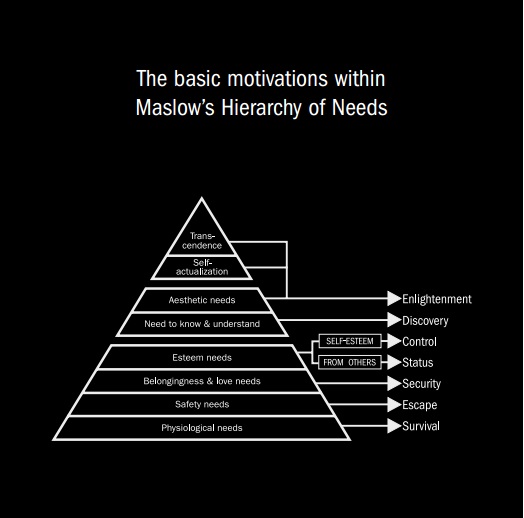
Both of these 'personality' categories can be simplified down by Mills' concept of The Power Elite (1956): identity, aspiration, instruction and escapism are ways in which every human being can be swayed by the media, though they each look for different things in each category. This is again reinforced by Blumer and Katz' Uses and Gratification (1974), which state personal identity, information, entertainment and social integration is what audiences look for in media texts, and is therefore what advertising bodies should aspire to achieve for effective selling. Maslow also developed the Hierarchy of Needs that applies to all humans in general, identifying what qualifies as basic physiological and safety needs, up to psychological needs like love/belonging and self-esteem, all the way up to self-fulfilment needs like self-actualisation. Humans often aim for things they can no yet achieve, and so by using advertising fulfilling the highest of these goals, it implies that a product can reach this for the individual that purchases it. In many ways these theories are about appealing to an audience's personal desires and subconscious, however as these things are different to each person experiencing them, a good advert can use them to reach their preferred target audience.
When entering into the initial stages of creating a product, research into areas like the market, the target audience, and the product of said product, are important in order to collect the relevant information that will lead to an understanding of what to create. There are many ways to collect these pieces of information, and choosing the method appropriate to the data you're aiming to collect can make the investigation easier and more effective and accurate.
Types of Research in the Creative Media Industry
Audienceresearch investigates information around who is going to be buying or viewing your product (your target audience). For example, knowing the gender, age and cultural background of the consumer you want to target can help to direct the ways in which you can get their attention and sell your product. Knowing where to raise awareness of your product, and times it will be seen, can ensure the right people see your advertisement.
Research into the marketcan show what is already selling well in the industry you are looking at, and having awareness of possible competition your product might face can highlight weak areas in their campaigns, and show you where you could better them to gain more profit. Many existing products and companies in the market also have additional merchandising, social networking partnerships and expansions that may indicate how follow-ons can benefit a campaign.
Productionresearch can explain many questions surrounding cost, content and methods of creating your product. It can be useful to know the price of the production of your product, as well as possible ways to be efficient and possibly decrease the initial cost. Research into this area can also show you how to make your actual product better (e.g. what materials are high-quality and durable if your product is a physical object), and indicate the ways in which you can gain the most effective profit from its sales.
Investigation into research methodsthemselves can highlight the most effective ways of gathering information, and show you which type is most effective for what you're trying to find out.
Quantitative and Qualitative Research
Quantitative data is often shown through numbers and graphs, as it can be measured and counted. This sort of information can be collected in online surveys (see below) when asking someone to rate a subject on a scale of 1 to 10; the quantitive values can then be collected in numerical form and used. This can be useful when trying to track easy patterns in people's reactions, or have a solid ideas of an audience's preferences (e.g. through a bar graph or pie chart), however it does not show what people's personal opinions are, and so cannot be overly detailed when it comes to tailoring your product.
Qualitative data is the opposite: although it cannot be used to clearly map trends, it can provide in-depth information about specific questions. For example, focus groups (see below) will produce qualitative data through their verbal or sometimes written responses to questions asked to them in person. This sort of data can be very useful in the later stages of research, as it can give very specific and detailed information about a small area - often once you already know the subject you need to gain data about. However, it can sometimes be hard to see an overview of the results collected as each one will be unique.
Primary and Secondary Research
Interviews allow you to directly talk and find out the opinions of the general public, or specific people from your target audience. These can take place in public places by asking passersby to take part in your research, or in more controlled circumstances like private appointments. The strengths of this method include the fact that an interviewer can latch onto something the subject has said, and choose to question them further on it, and a range of results can often be found. However, the method is limited later into a project, when a more selective audience of people need to be targeted, as opposed to a mix of the general public.
Online Surveys are a method which uses the internet or email to get a large number of responses is potentially a very short amount of time. This has become increasingly popular with the growth of social media, as a small link can instantly send people to a comprehensive or even simple survey from anywhere with an internet connection. A benefit of this method is that it is less costly than most other methods, and very quick and easy to get out to a lot of people. However, it does mean that it becomes harder to monitor the types of people answering your questions and therefore potentially misleading for a close analysis of an audience.
Similarly, questionnaires can be sent out to a large number of people to collect varied results. While traditionally on paper, questionnaires are very like online surveys, but usually are more flexible in the answers that can be provided. Open-ended questions are more common in this method, and they can be useful for receiving unexpected responses. Again, like surveys, it can be hard to control who answers your questionnaires, and the flexibility of the method means that it can be hard to gain clear averages and patterns.
Focus Groups are selective interviews with multiple people taken directly from your target audience. These people meet with a facilitator from the company selling the product, and are often asked to examine or try the product and give feedback either through their own comments, or in response to -in-depth questions. The strengths of focus groups include the fact that everyone involved is from the audience you are trying to appeal to, and so their detailed responses are more likely to be useful. However, the smaller a focus the group the more niche the product and potentially the less appeal to people outside that audience.
Secondary research can include excerpts or whole sections of information from sources such as books, newspaper or journal articles, websites, archives, visual photographs or videos etc. Often secondary sources are used as the foundation of research in order to get a general idea of a subject, and give a direction for what sort of things can be asked later in primary research. The benefit of secondary research is that it is relatively easy to come by, and can potentially be incredibly helpful, however as the research is completed by someone uninvolved in your personal project it can often be too general, or specific to another topic. The reliability can also be called into question in some cases, for example when using the internet and videos; and interpretation of sources like photographs can be misleading.
Red Riding Hood shares the same style of photographic animation as my original test using images from one of the first ever stop motion films: Muybridge's 'Horse in Motion' from 1878. Though I added to this in my final piece by also having an animated set and wolf, the pure style of creating character and movement through individual photographs stayed consistent as I was very happy with the results of my initial test.
The main piece of feedback I received for my test run was that the figures needed to be double-sided (when my horse turned around originally it was blank on the other side). This, however, was not an issue in my final piece as I had designed my characters and set to never reveal the back of each figure: Red only ever travels right, and my revolving set moved with her, so there was no need to see the other side of each photographic frame as when I was experimenting with Muybridge's Horse. Furthermore, as I was photographing my own images to be animated (as opposed to using Muybridge's pictures) I was able to plan around the possibility that the back of my figure might be seen, and therefore ensure it was unnecessary to ever break the 180 degree rule.
Though the style of animation is the same, I realised in my test run that I would have liked the movement to have been smoother - I had used 24fps in my film, however had recycled the photographic frames three times before I switched to the next image. Though the movement of the figure was at 24fps, it meant that the photograph itself was animated at a third of that, and therefore became more jerky. For my final piece, I ensured that the movement of my figures worked smoothly at 24fps, however still recycled each photograph twice before changing to the next image in order to be economical. This meant that the animation flowed a lot more naturally, but still had the quirky and 'handmade' characteristics of stop motion animation.
Comparison with Existing Products
The primary influence for my style of animated photographic frames within a second animation of the 'outside' world was from a short film named 'Wolf And Pig' from Taijin Takeuchi on YouTube. The filmmaker used whole photographs to present the narrative of a wolf chasing a pig around Tokyo, while also incorporating elements in the 'real world' such as a sink or wall to create a connection between the sets. This inspired me to use a 'world within a world' style in my animation. Furthermore, since entering into the production of my film I realised the same style of stop motion is used in the title sequence of Russell Howard's Good News on BBC, which likely subconsciously influenced the aesthetic of my stop motion.
As this was my first time attempting to create a stop motion animation, I wasn't able to reach the professional standards shown in both of these inspirations. Furthermore, the resources available to me and restricted time in which I was able to create my animation contributed to the fact that I wasn't able to create something so effective. The imaginative way that Takeuchi used his apartment and its various household items in his narrative is something I would've liked to mirror more closely: his use of a sink in place of a swimming pool, and a wall to show stairs created a wonderful effect - though was too ambitious for my project. I would also have liked to create more movement in my set like Russell Howard's title sequence: the props and text jerk around slightly as he moves in order to create a more vibrant and lively scene. Though my set revolved and included the animated wolf, more movement would have replicated the atmosphere of a forest more effectively.
However, I do feel like the quality of my animation is high given the circumstances, and I was able to approach a simple narrative in a similar way to 'Wolf and Pig', and also mirrored the smooth but interesting animation style following a single moving figure in a semi-static environment much like Russell Howard's title sequence.
Strengths and Limitations
After completing my animation I collected peer feedback from my classmates, and received an overall positive response. I asked, on a scale of 1 to 10, how strong various aspects of my animation were. Creative Qualities, Aesthetic and Editing scored the highest, indicating I had succeeded in my goal of creating an interesting and engaging visual narrative that my target audience of 7-12 year olds would enjoy. Furthermore, the fact that aesthetic and creativity was rated highly also suggests that my secondary audience of 16-34 year olds interested in creative filmmaking would also be attracted to my animation.
However, in order to collect more data for a more accurate and reliable response, I created an online survey (which can be found here: https://www.surveymonkey.co.uk/r/BP3PSDY) using the free website SurveyMonkey, that asked similar questions to those I had given to my peers. Again, I received mainly positive feedback and some constructive criticism. The results confirmed that many thought a target audience of 7-12 year olds would be interested in my animation, and there was an overwhelming positive indication that my stop motion was a creative interpretation of the classic fairytale (this again proved I had achieved my goal of creating a visually pleasing retelling). Again, aesthetic, creativity and editing scored as the strongest elements of my film.
Specific successes people pointed out within my work was the use of colour (something I had initially aimed to exaggerate, with inspiration from Hardwicke's Red Riding Hood (2011) as inspiration), as well as the creativity of animating photographic frames within a separate set (specifically 'when Red Riding Hood is running'). Again, I was happy with this response as I had chosen my style of stop motion animation to be striking and quirky. Constructive criticism I received centered mainly around the wolf - something I agree with. I had originally planned to use shadow silhouettes of the wolf, as opposed to cardboard figures, however when it came to filming I did not have enough control over lighting to create a distinguishable silhouette, and so had to improvise with my original figures. If I were to repeat this project I would spend more time thinking of another way to present the wolf, or gain more control over my lighting. Another suggestion was that 'the narrative moves a little too quickly', and again I agree, however due to the fact this was my first time creating a stop motion animation, and I was very restricted when it came to deadlines and the resources available to me, I feel I made a strong animation given the circumstances. This is reflected in narrative scoring one of the lowest on my questionnaire, and I would definitely like to be able to take more time in my storytelling in the future - perhaps by shortening the length of my story in the first place, and therefore taking more time and care on a smaller project.
'How successful so you think the following elements are?'
'What target audience would be attracted to this project?'
'Is this an interesting version of the Red Riding Hood fairytale?'
'Is there anything else that stood out as particularly successful?'
'Is there anything else I could improve?'
Overall, I am happy with the stop motion animation I was able to create. I completed the brief of producing a short animated nursery rhyme/fairytale for children's television, as well as succeeding in my own personal goal of creating an interesting and visually pleasing retelling of Red Riding Hood. There were several elements I had originally planned to include in my ambitious first plan that had to be taken out due to restrictions on time and resources (e.g. the transition of 3D props into the 2D photographic frames; the wolf only shown as a shadowed silhouette), however I feel that simplifying my idea at the beginning of filming meant I could create a stronger animation with what I was able to carry out. In hindsight, I would've like to create a clearer storyline - but like I said in my pitch, I chose Red Riding Hood because the storyline is so well known I had creative freedom to play around with how I presented it, without making it confusing to understand. My focus on the style of photographic animation inside a set was definitely worth it, and the hours I put into pre-production, filming and then editing and sound meant that I was left with a high quality stop motion animation in the end.